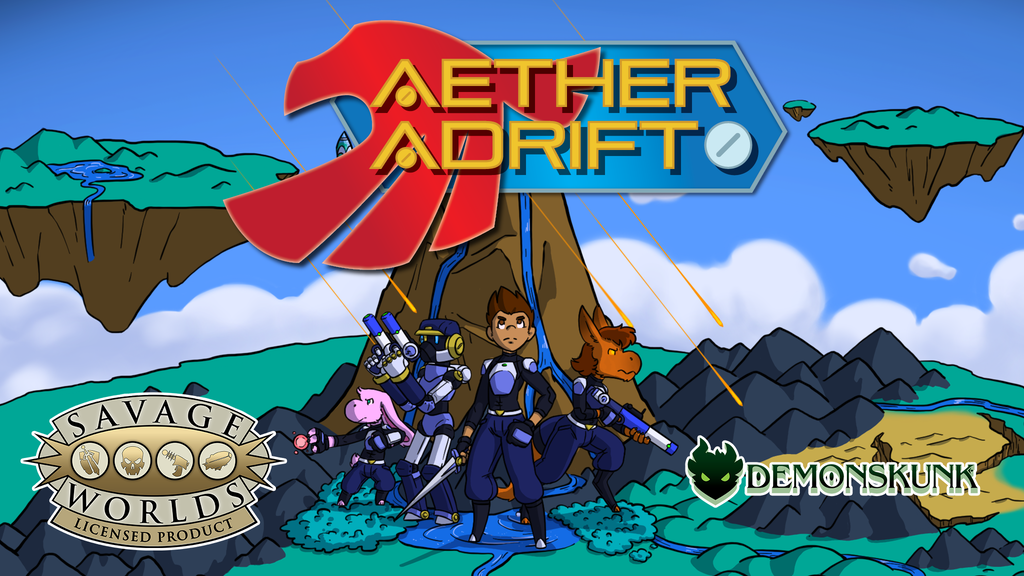
Explore a world of floating islands, Delve into ancient techno-ruins, fight alien beasts and war machines to discover lost technologies
Shipping Fees: Due to fluctuating global shipping rates, we will be charging shipping fees at a later date. We will keep you updated through Kickstarter Updates for when shipping fees will be applied to your survey. Thank you for your patience and understanding!
Latest Updates from Our Project:
Surveys and Late Backing coming soon!
almost 5 years ago
– Fri, Dec 17, 2021 at 01:27:25 PM
This post is for backers only. Please visit Kickstarter.com and log in to read.
Campaign Complete!
almost 5 years ago
– Fri, Dec 10, 2021 at 06:42:47 AM
We couldn't have done it without you!
To all of our supporters, whether you pledged money or not, we want to extend a heartfelt thank you for believing in us. It has been our dream to produce a tabletop setting of our own, and the level of support we received is extremely validating. You've done your part, now it's our turn to show you that your faith was not misplaced.
Things have been hectic on our end; Sam has been busy taking care of his mother while she's in hospital, so we'll have more information on the post-campaign proceedings in the next few days.
We're Funded! & Foundry and Roll20 Support!
almost 5 years ago
– Mon, Nov 29, 2021 at 06:36:24 PM
Aether Adrift is 100% Funded!
First of all, thank you to all of our backers for helping us get this far - we couldn't have made it without your support! Thanks to all of you we have the chance to make Aether Adrift a reality.
But we can't stop now! The funding goal was the bare minimum we needed to bring Aether Adrift to you, and every dollar you all pledge beyond that goes to making it even better! Let's reach for the stars and rocket past our Stretch Goals together, Voyagers, and make Aether Adrift the best game it can be!
Foundry and Roll20 Logos
Virtual Tabletop Support
Many gaming groups moved their regular games online in the wake of the pandemic, and many more gaming groups now include members from all over the world. To make Aether Adrift as accessible as possible for all players, we have decided to include Virtual Tabletop support as part of our Kickstarter Campaign. We will have more information for you as we research how best to implement Aether Adrift on these platforms.
The Stretch Goals graphic has been adjusted to reflect these changes.
[Voyager Report] Species Spotlight: Robots
almost 5 years ago
– Sun, Nov 28, 2021 at 08:42:00 PM
Voyager Command here with the third Species Spotlight. This time we're learning more about the humans' faithful companions, the Robots, which... technically aren't a species, as they aren't alive, but fall under this category anyway.
Robot Model Sheet
Anatomy
Robots are artificially intelligent mechanical constructs. Robots vary in height and weight, but most stand between 5 and 6 feet tall. Most robots are built with almost identical proportions to humans so that they can use human tools and equipment more easily, but the sheer variations of robot design can be staggering. Some robots are designed to resemble animals, and some robot designs are wholly unique, suited to their intended duty.
A robot's external casing is comprised of multiple interlocking pieces made of a durable lightweight composite that can flex and bend, making them more flexible than they look. Their internal components are EMP-hardened silicon electronics that are padded and supported to resist physical impacts. A standard robot's face is a high density LED panel that allows them to express a variety of emotions, facial expressions, and emoticons to make them more personable.
All robots have a high capacity battery typically mounted on their back. This battery can power the robot for roughly 7 days before needing an 8 hour charge.
Various Robots
Purpose
A robot is defined by its purpose. The shape of its body, the personality it is programmed with, and the tools integrated into its body are all in service of its purpose. A wilderness search and rescue robot might be outfitted with infravision for night rescues, an integrated blade for cutting through thick foliage, and a tow hook to traverse vertical obstacles. A bodyguard robot might be fitted with enhanced armor for protection, an arm cannon to retaliate against threats, and wheeled feet to quickly move itself and its detail into a better position.
All robots are programmed with the Robot Code of Ethics, a simple set of rules that ensure the robots will preserve human life as effectively as possible, and when humans are not in danger, will protect themselves as much as possible. The hard coding of Humans into the rules, and not Mikwa or Fulgori has led to command structure issues in voyager teams without a human presence.
While robots might seem like thinking and feeling beings, in actuality their emotions are simulated in service of their purpose as assistants to humans. With that said, however, humans often treat robots like people. Humans call robots by name and their preferred pronouns, conversing with and confiding in them, and even risking their lives for them in some cases.
Zooform Robots
Zooform Robots
Animals are not a good fit for interstellar travel. It's impossible to explain the mechanics of cryogenic freezing, they panic when you try to put them into the cryopods, and they are an extra resource expenditure when you finally reach your destination.
Zooform robots have most of the benefits of animal companions with none of the downsides. A zooform robot is just as intelligent as a humanoid robot, capable of following advanced orders, and even speech. Zooform robots have benefits and drawbacks because of their body shape. A quadruped frame is capable of carrying much more equipment without overloading its servos, and can more easily navigate over rough and uneven ground; conversely they cannot use their forelimbs as hands while moving, and must mount weapon systems on hard points on their back. An aeromorph frame can fly freely through the air and use its limbs as both feet and hands, but they are limited in carry weight and are considerably less effective when conditions limit their flight.
Some zooform robots are humanoid, but designed to resemble bipedal animals like Kangaroos or meerkats. These design choices are purely aesthetic.
Robots Performing Their Duty
Glitches
Some robots have begun to express unusual behaviors and personality quirks that they were not originally programmed with. Robots are intended to have routine maintenance performed by a human every year or so to ensure that they are functioning properly; but because all human crew members except the Admiral were in cryosleep, the robot crew remained active without a human checker for 20 years.
These glitches include, but are not limited to: A heavy lifting robot becoming obsessed with lifting heavier and heavier things and showing off to his 'bros' how much he can lift; A repair robot turning to an imagined camera and saying spanish catch phrases with, some crew members have stated, perfect comedic timing; and a maintenance robot becoming obsessed with precursor technology to the point of shirking his duty to examine and disassemble precursor objects.
Most of these glitches aren't problematic enough to warrant the reallocation of resources to correct them, and many of the crew members find the quirks charming. This combined with the lack of availability of replacement parts has meant that many of these 'quirks' have been left to develop. There is some worry that compounding glitches could lead to robots becoming self aware and truly sentient, but Voyager Command has deemed the risk of negative consequences to be within acceptable limits.
[Voyager Report] Species Spotlight: Mikwa
almost 5 years ago
– Tue, Nov 23, 2021 at 10:29:37 AM
Voyager Command here with another Species Spotlight. This time we'll be learning about our bijou bunny-donkeys, the Mikwa!
Mikwa Model Sheet
Anatomy
Mikwa are intelligent humanoids that typically stand 3 feet (0.9 meters), on average. Mikwa have long prehensile lop ears that hang behind their head, a bulbous rounded snout that gives them a soft and jovial look, and mixed slicing and crushing teeth that suggest an omnivorous diet. A Mikwa's body is covered in soft fur, and are capable of growing hair on their heads and faces. This hair is sometimes the same color as their fur, and sometimes not.
Mikwa have long arms and short legs proportionate to a human, with an elongated torso. Their legs end in plantigrade paws, and their arms end in large 4 fingered hands with thick black claws. Mikwa do not show much sexual dimorphism, save for the expression of breasts in females, and It is possible that mikwa sex is not as easily divided as human sex.
Mikwa ears vary wildly in length, from short ears that hang down to the shoulders to long ears that drag on the ground. Mikwa ears are almost fully prehensile, and can be controlled much like a second set of arms, though without the ability to grasp or hold items.
A Mikwa Town
Society
Mikwa society is something of an anarcho-collectivist commune. Most mikwa settlements have either a single wise individual, or a council of trusted individuals that can be turned to for matters that affect the group as a whole, or when a dispute cannot be settled between private parties. Outside of these instances no mikwa holds any more power than any other mikwa.
Mikwa towns are small, rarely numbering over a couple hundred. Mikwa do not draw a very strong distinction between friend and family, so their small towns are often very tightly knit. Children are raised and taught communally, helping to strengthen their community bond.
Mikwa jobs are not assigned; a young mikwa will often apprentice under several experienced tutors until they find a creative pursuit that speaks to them. Mikwa encourage creativity, and so students are encouraged to explore and experiment in ways even their teacher may not have considered - or to explore entirely new pursuits unmentored if they wish!
Mikwa towns rarely have any sort of economy. They simply help each other out with the expectation that the recipient will return the kindness if and when he can. A cobbler will make shoes for a blacksmith with the expectation that the blacksmith will sharpen the cobbler's knives when they dull. Mikwa chase their passions tirelessly, some to the point of obsession.
All mikwa homes have a communal area outside where friends and family can visit freely, with a private interior area for quiet moments. Mikwa freely share affection, and often greet each other by bumping noses - coloquially known as a 'snoot boop' - which is analogous to a human kiss. Fulgori, human and even robot friends are not excluded from this greeting.
A Mikwa Mechanic
Technology
The mikwa can seem antiquated or ramshackle compared to the fulgori, but in terms of capability they are on par. Much of mikwa technology is repurposed and refurbished fulgori technology that has been lovingly maintained and tinkered with over the years to get the most use out of it. Much of their technology is analog, requiring hand or foot power to work. Mikwa put a large emphasis on aesthetics. No two mikwa devices are identical, and most mikwa can't help but decorate or tinker with their equipment until it is as personal as their clothing.
Mikwa homes typically have electric lighting at a minimum, and often running water as well. Oil generators power their homes. Their generators burn rarana oil at a lower temperature than fulgori generators, meaning they produce less power, but last longer and don't foul the oil, causing them to produce a pleasantly sweet smell.
Mikwa mechanics are masters of adaption, able to marry fulgori, human, and even precursor technology together into new useful inventions. In fact, mikwa sometimes seem to possess an almost instinctual understanding of precursor technology, able to work and dismantle devices they've never seen as if they'd been using them all their lives.
For defense, Mikwa employ worked leather, wood, and metal armor and weapons, alongside lovingly maintained fulgori friction lock firearms, and unusual custom made weapons. The most unique mikwa weapons are those that attach to their ears, allowing them to quickly strike with dual weights, or slash with ear-blades in a twirling dance.
Mikwa Resting
Nomads
Not all mikwa live in towns. Some live in nomadic bands that migrate between several areas, establishing temporary settlements. These settlement areas often have semi-cultivated farm gardens and grazing animals that can supply food and materials. They also tend to be near precursor settlements for reasons not currently known to the Voyagers.
Nomadic mikwa are less likely to employ electrical conveniences, and are therefore much better survivalists and pathfinders. Nomadic mikwa will often come to the aid of anyone they find in danger out in the wilderness. This sometimes leading to nomads joining settled mikwa to teach some to be survivalists, and townies joining nomads to teach them to use and maintain technological aids.
Relationship with Humans
Mikwa have become very close with humans in the short time they've been in contact with each other. Mikwa were the first species to enter into the Voyager coalition with the human settlers and have been instrumental in teaching them the ins and outs of survival on the island of Elisi. The main Voyager base, Odal, regularly trades with its mikwa sister city, Qochawasi. It is not uncommon to find mikwa living in human settlements and vice versa.